
Slots & game rules / CASHIER TRACE NOTES
What is a push in blackjack? A returned stake, not a win
 Partner offers · Country: United KingdomUpdated 11 November 2026
Advertising. Bonus amounts, ratings and review counts are supplied by advertisers and have not been independently verified. Check eligibility and current terms with the operator. 18+. These international campaigns have no dedicated GB offer; GB availability has not been confirmed.

A push in blackjack is a tied main-hand result in which the main stake is returned without profit. The exact table rules matter: equal numerical totals do not always mean equivalent hands, and side bets settle separately.
This explanation concerns settlement, rather than decisions about drawing cards. It does not recommend a betting system or suggest that a sequence of pushes makes a future win more likely.
Great Britain · GBP · 18+Editorial check: 11 November 2026
On this page
- Follow the main stake through the result
- When are equal totals a push?
- A push on the main hand can coexist with a loss elsewhere
- Read the round history before reporting an error
- Compare the word push across games carefully
- A push is a settlement of a particular wager
- Equal totals can be formed by different cards
- A soft total and a hard total can share the same number
- A natural blackjack is not simply every total of twenty-one
- Equal bust totals do not establish a push
- Follow the main stake through a simple ledger
- A lost side stake can coexist with a main-hand push
- A pair-shaped hand does not settle every position by itself
- Several hands require a result for each selected hand
- A split creates separate hand records
- A confirmed push after a larger committed stake needs that full stake
- Insurance is a separate selected position where offered
- A chip denomination may be only part of the selected amount
- Wait for the completed settlement before reading an animation as final
- A practice balance and an account balance are not the same record
- The same closing balance can hide different round histories
- Match the rule source to the actual release
- A proportion of pushed hands is not a proportion of money returned
- A voided wager and a push can have a similar receipt but different records
- A useful enquiry separates the wager, hand and receipt
- Questions about blackjack pushes
- Sources
Follow the main stake through the result
Consider an illustrative £8 main bet. The stake is committed to the hand. If that hand pushes under the applicable rules, £8 returns. The amount received is £8 and the profit on that main bet is £0. Calling the returned stake an £8 win would confuse receipt with profit.
If the account displayed £50 before the example bet, it might show £42 while the £8 stake is committed, then £50 after its return. Interfaces can present reservations and settlements differently, so use the round record rather than expecting every screen to follow that exact sequence.
| Example main-hand result | Stake | Returned on that bet | Net change from that bet |
|---|---|---|---|
| Push | £8 | £8 | £0 |
| Lost main hand | £8 | £0 | −£8 |
| Winning main hand | £8 | Depends on the applicable payout | Check the stated rule |
When are equal totals a push?
Grosvenor's published blackjack rules describe matching non-busted main-hand totals as a push, with the original stake returned. Their specific game pages also distinguish a natural blackjack from a hand that reaches 21 using more cards. Check the named version instead of applying a generic tie slogan.
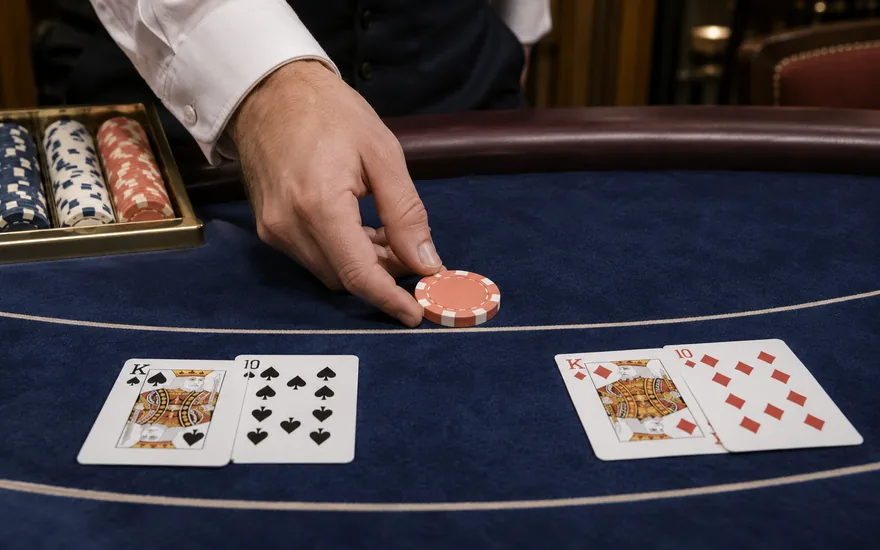
A two-card blackjack and a three-card 21 can both display 21 while having different standing under the rules. Equally, a player who busts should not assume a later dealer bust creates a tie. The sequence and settlement rules matter; numerical equality alone is not enough to reconstruct an outcome.
Read the help panel for the actual table, especially when the title adds special rules. A modified blackjack product can change how particular outcomes settle. If a result appears unexpected, record the table name and round identifier before looking for an explanation from a different edition.
A push on the main hand can coexist with a loss elsewhere
Side bets are separate wagers with their own conditions. A main-hand push does not automatically return money staked on a pair, card combination or another side outcome. This is why the total change in an account can be negative even when the main-hand result says push.
In a hypothetical round, £8 on the main hand pushes and a separate £2 side bet loses. The main stake returns £8; the side bet returns nothing. Across the two bets, £10 was committed and £8 returned, producing a £2 net loss. The example does not name or recommend a side bet.
Do the same separation for multiple played hands. One hand's tie does not establish the result of another hand after a split. Give each recorded stake and settlement its own line before adding up the round. A single prominent animation may not describe the entire account movement.
Read the round history before reporting an error
Write down the exact table version, round number, main stake, any additional stakes and the settlement of each. Note whether the displayed amount includes returned stakes. This usually produces a clearer question than asking why a win disappeared when the main result was actually a tie.
If the records do not reconcile, ask the operator for the rule applied to that specific hand and the itemised settlement. Do not place another wager to recreate the result. A written complaint can present the record and disputed amount without risking additional money.
Compare the word push across games carefully
Where a history screen reports only a combined round total, request the components instead of guessing which wager pushed. The same final account change can result from different combinations of returned stakes and lost side bets, so the balance alone cannot reconstruct the hand.
The general idea of a returned stake also appears in baccarat. However, a baccarat tie can make a separate Tie wager win while Player or Banker stakes are returned. Our baccarat tie explanation keeps those three betting positions distinct.
For other amount questions, the game notes index separates a casino payment from a wager and a wager from its result. A returned stake is a settlement description. It does not tell you whether a game is affordable or whether continuing a session is a good decision.
A push is a settlement of a particular wager
Attach the word push to the wager whose stake came back. If you placed only one main bet, that may describe the entire round. If you also selected a side bet or played another hand, there are more results to account for.
A credit in the history can look like a gain because money moves back into the available balance. Follow it one step further back: the same money left the balance when the stake was accepted. Returning it closes that wager with no profit.
Read each position across the record: amount staked, result, amount received. Then add the receipts and subtract all stakes for the round. This order keeps a correctly settled main-hand push from hiding a separate loss, or a separate win from being mistaken for profit on the tied hand.
Equal totals can be formed by different cards
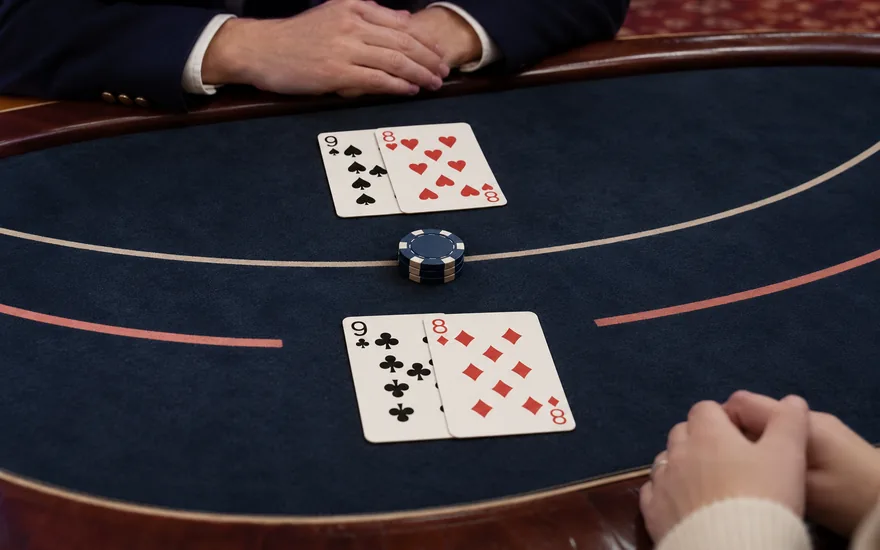
In an ordinary equal-total example, a player's ten and eight and a dealer's nine and nine both produce eighteen. The card combinations differ, while the totals match. The settlement still needs the rules of the specific release.
The Grosvenor rules linked on this page describe returning the main bet for the relevant equal non-bust totals. That source-specific statement is not a claim that every blackjack variant has identical exceptions or side-wager treatment.
For a record enquiry, retain the actual cards or reported final totals where available. A label saying eighteen is useful context, but the product identity matters when another rule distinguishes the way the total was formed.
A natural blackjack is not simply every total of twenty-one
The linked All Bets Blackjack rules distinguish a two-card blackjack from an ordinary twenty-one, including the treatment of an ace and ten-value card after a split. That product distinction matters before a result is described as a push.
A player can therefore not conclude that every displayed twenty-one must tie with every other twenty-one merely by comparing the digits. The category of the hand may be relevant. The specific release's rule should remain attached to that category.
Do not use another game's paytable to fill an uncertainty. A general explanation of push can identify the issue, but the named product and hand record determine how a particular natural or split-hand total is treated.
Equal bust totals do not establish a push
The fact that two numbers match does not make every pair a valid draw. The linked game rules separately describe a player bust as an automatic loss for that hand. Comparing two over-twenty-one totals without that condition would be incomplete.
For illustration, two totals of twenty-two should not be treated as an ordinary equal non-bust example merely because both use the same number. The relevant rules determine the effect of the player's bust and the sequence.
This is why an enquiry should identify the completed hand and product rather than state only that the dealer later had the same value. Equality is one field in the explanation, not a replacement for all the settlement conditions.
Follow the main stake through a simple ledger
Take a hypothetical opening balance of £20 and a £2 main wager. Accepting the wager leaves £18 available. A confirmed push returns the £2, restoring the balance to £20 if no other activity occurs.
The entries balance: £20 minus £2 plus £2 equals £20. Treating the returned stake as profit would incorrectly produce £22. The small credit is easy to misread when a history screen shows receipts more prominently than the earlier debit.
If a real record closes at £19.50, look for the other £0.50 movement. It might belong to a separately recorded position or another transaction; the balance alone leaves the cause open. Compare the entries before challenging the £2 return, and keep any unexplained difference as a separate question.
A lost side stake can coexist with a main-hand push
Consider an imaginary £2 main wager and a separate £0.50 side wager. If the main stake is returned while the side wager loses under its own rule, the round's total receipt is £2 against £2.50 staked.
The simplified net result is a £0.50 loss despite the main hand's push. Nothing in the word push promises that the side wager is returned too. The two positions need separate settlement descriptions.
The example does not assign that result to any particular side-bet product. Use the actual selected position and its published rule. The purpose is to show why an account can decrease without contradicting a correctly returned main stake.
A pair-shaped hand does not settle every position by itself
Two nines give the main hand a total of eighteen. In a product offering a pair-related side wager, those same cards may also be evaluated against a different set of conditions. The cards are shared evidence; the wagers remain separate.
Read the side paytable for the category in question. Equal card values alone may leave relevant details unresolved, and a main-hand push tells you nothing about which side category was recorded. Start with the selected wager's name before looking up its treatment.
A useful saved record shows both stakes beside the cards and both settlement entries. If the history shows only the main hand, ask for the side-wager entry instead of assuming it was included. That keeps a dispute about a missing position separate from a dispute about how the cards were classified.
Several hands require a result for each selected hand
Some releases allow more than one hand. A push on one hand does not describe the result of another. Keep the stake and receipt associated with each hand rather than applying one label to the whole screen.
For a fictional two-hand record with £2 on each, one confirmed push and one confirmed loss would return £2 against £4 staked. The simplified net loss is £2. The push remains correctly described for the first hand.
This is a settlement example, not a recommendation to play multiple hands. The actual product determines which selections are available. A complete-looking table layout does not prove that every displayed position was selected in the round being questioned.
A split creates separate hand records
Where a game permits splitting, the resulting hands should be followed separately. The original stake and any additional committed stake are part of the full wager record. One final hand's result cannot explain the other hand automatically.
If an illustrative split results in two £2 hands, one push and one loss produce a £2 receipt against £4 staked under the stated example. Counting only the original £2 as the total wager would misstate the net result.
The linked product rules describe their own split conditions and exceptions. Do not transfer them to every blackjack release. A general push explanation helps identify which hand needs attention; the game's own rules establish its treatment.
A confirmed push after a larger committed stake needs that full stake
An initial stake and a later added stake can form the amount committed to a hand under a product's rules. If a push is confirmed for that full amount, the relevant returned stake must be compared with the complete committed wager.
For a hypothetical record, an initial £1 plus another £1 produces £2 committed. A £2 return would restore that full stake. Comparing the return only with the initial pound would incorrectly describe the second pound as profit.
This example does not establish when doubling is offered or how every special dealer outcome is treated. Those questions need the particular release. It illustrates why the wager history must be complete before a receipt is interpreted.
Insurance is a separate selected position where offered
If a release offers insurance and the reader selects it, that stake needs its own rule and settlement entry. The main-hand result alone does not determine the net effect of every position on the table.
The linked All Bets Blackjack description treats insurance separately from the main and other side positions. The article does not extend that product's entire rule set to unrelated releases or invent an insurance result for a round without a record.
When reviewing a balance change, identify whether an additional position was actually selected. Do not assume it was present merely because the interface displayed a control. The available option and the authorised wager are different observations.
A chip denomination may be only part of the selected amount
The value shown on a chip control can be a building block for a stake. Several selected chips or positions can produce a larger total. The full wager should be identified from the actual selection and record.
A fictional five-chip selection at £0.20 each totals £1 if those are the stated components. A photograph showing one £0.20 chip would not prove the round's full stake. The example demonstrates the unit, not a universal interface design.
The maximum bonus-bet note explains another reason the full selected amount can matter. A game's acceptance of a selection does not automatically establish the treatment of that wager under a separate promotion.
Wait for the completed settlement before reading an animation as final
A screen can show intermediate cards, totals and returned-chip movement before the final account entry is available. An intermediate display should not be substituted for the completed round record.
If a remembered total changed after another card, retain that sequence where it is supported. Do not report the earlier number as the final hand merely because it is the screenshot that was saved. The ending state matters to the rule.
The article does not prescribe a universal animation order or display delay. It distinguishes a visual observation from the completed result. The organisation holding the round history is the appropriate source for the actual account event.
A practice balance and an account balance are not the same record
A demo can help identify the push label or locate a rule panel. Its virtual credit is not money available to withdraw, and its displayed currency does not establish the stake in another account.
A favourable practice sequence cannot prove that a real-money session will behave the same way. The purpose of the explanation is interpreting a settlement term, not supplying a method for producing it repeatedly.
If the product or version differs from the account game, preserve that boundary. A similar title or table image is not enough to establish identical exceptions, side wagers or stake treatment.
The same closing balance can hide different round histories
An unchanged balance does not prove that a particular hand pushed. Another credit or result can offset a loss in a larger sequence. Conversely, a lower balance does not prove that a correctly recorded push was wrong.
For an illustrative account record, a £1 loss followed by an unrelated £1 credit leaves the original balance unchanged. That is not the same sequence as a £1 main stake being returned by a push. The totals match while the events differ.
Use the round-level record to identify the settlement. A balance comparison can locate a question, but it cannot reconstruct every intervening event without the entries and their labels.
Match the rule source to the actual release
Blackjack variants can have different special conditions and side products. The general meaning of a returned main stake does not establish every exception. Retain the named release and the relevant wording.
If the source now describes another version, do not silently use its details to explain an older account round. A publication review date, product date and transaction date are separate pieces of context.
Where the evidence is incomplete, ask which rule applied to the identified hand. An unsupported number or remembered paytable should not be substituted merely to make the result appear settled.
A proportion of pushed hands is not a proportion of money returned
Outcome counts give every hand one place in a tally. Money totals give each stake its full value. They answer different questions when the amounts vary, which is why a list of push labels cannot replace the stake record.
Imagine one £1 main stake returned by a confirmed push and one separate £10 main stake lost. One of two hands pushed: fifty per cent of the hand count. The receipt was £1 against £11 staked, leaving a £10 loss across these hypothetical hands.
Reversing the amounts changes the money calculation while leaving the outcome count unchanged. A £10 push and a £1 loss would return £10 against the same £11 staked. Neither example estimates blackjack probabilities; together they show exactly what disappears when amounts are left out.
A short demo history has the additional limit of being a small sample. It can show which labels appeared, but the proportion observed there gives no dependable forecast for the next session.
A voided wager and a push can have a similar receipt but different records
If a provider explicitly describes a wager as void, preserve that description rather than relabelling it as a push merely because a stake was returned. The account event and the game outcome are different fields.
Two sequences can both restore a stake while having different reasons and histories. A return by an equal-hand settlement is not proof of a cancellation, and a cancellation is not proof that the completed hands tied.
For an enquiry, identify the label and reference actually supplied. The publication does not infer a technical cause from a returned amount alone. Keeping the event's description prevents the same receipt from being used to tell a different story about the round.
A useful enquiry separates the wager, hand and receipt
Identify the available round reference, main stake, selected additional positions and completed result. Then state which receipt or rule appears inconsistent. This gives the organisation a specific relationship to explain.
Keep private evidence with the recognised secure account process. A publication correction can usually name the sentence and public source without disclosing a full account history. The contact page distinguishes those tasks.
A blackjack push is a return of the relevant stake under the game's rule. It is not a promise that every position in the round breaks even or that an account balance remains unchanged after other activity. Keeping those units separate makes the explanation precise.
Questions about blackjack pushes
Is a push a blackjack win?
No. A normal push returns the affected main stake without profit. Use the table's exact rules for special outcomes.
Do all side bets push too?
No. Each side wager has its own settlement rule. A main-hand tie does not determine its outcome.
Is every hand totalling 21 equivalent?
No. A natural blackjack can be treated differently from a multi-card 21. Check the game version and recorded hands.