
Publication & help / CASHIER TRACE NOTES
About Cashier Trace
 Partner offers · Country: United KingdomUpdated 11 November 2026
Advertising. Bonus amounts, ratings and review counts are supplied by advertisers and have not been independently verified. Check eligibility and current terms with the operator. 18+. These international campaigns have no dedicated GB offer; GB availability has not been confirmed.


Cashier Trace is an independent editorial project about the amounts and records attached to casino payments and game settlements in Great Britain. Its focus is narrow: identify what a figure measures before using it to explain a payment or result.
Great Britain · GBP · 18+Editorial check: 11 November 2026
On this page
- The questions we cover
- The market boundary
- What counts as evidence
- If you have an account dispute
- Why the publication begins with the meaning of an amount
- How the different reading sections fit together
- What independence means in the present version
- Which observations count as evidence
- Why product and release names remain important
- How to use the named-game catalogue
- What a practice game can and cannot show
- Why the examples do not claim personal gambling results
- How the illustrations support the subject
- What the navigation controls actually do
- What happens when a statement is incomplete or disputed
- How much personal information belongs with a general question
- How the publication is maintained without promising certainty
- Why the site avoids unexplained scores
- Why each article has its own narrow subject
- What to expect from a finished reading
- Sources
The questions we cover
Our monetary guides distinguish cashier transaction floors, withdrawal-transfer ceilings, allocation across destinations and rejected instructions. The bonus notes explain particular conditions without listing live offers. The game notes examine returned stakes, table minimums and the relationship between paid rounds and their component events.
The publication does not rank operators, supply casino accounts or process payments. It has no access to your bank, wallet or gambling history. A description of a published operator process is source evidence with a stated scope, not a recommendation to use that operator.

The market boundary
Great Britain means England, Scotland and Wales in the regulatory context used here. References to Gambling Commission guidance are not silently extended to Northern Ireland or the Republic of Ireland. Monetary examples use pounds sterling unless a source-specific currency is clearly identified.
Casino gambling is for adults aged eighteen and over. An explanation of a payment or rule is not a claim that gambling is suitable for a particular reader. Our support page links to independent services without requiring an operator account.
What counts as evidence
We distinguish primary published rules, observations from search research and editorial examples. We do not claim to have made deposits, played real-money rounds or tested withdrawal receipt times. Generated thematic photographs are illustrations, not proof of account access or a successful transaction.
Where a figure is inconsistent or a game version is uncertain, we omit the disputed detail or state the boundary. The editorial policy explains this approach. A complete-looking table is less useful than an accurate account of what a source actually establishes.
If you have an account dispute
Read each source within its stated product and date. The privacy information explains why private payment credentials and identity documents do not belong with this publication.
Use the operator's established complaints procedure, not this publication, for account-specific action. The complaints guide explains how to organise the amount, reference and chronology. Cashier Trace does not collect identity documents, submit claims or promise to recover funds.
Why the publication begins with the meaning of an amount
A figure can be exact while its meaning remains unclear. A displayed ten might describe one payment, a qualifying threshold, a total wager or a limit attached to a period. Knowing the digits is not enough to decide which question has been answered. Cashier Trace begins with the description around the figure because that is where an explanation becomes testable.
Those questions shape the articles. If a reader sees “£10 minimum”, the next step is to find out whether that means the smallest accepted deposit, the payment needed for a promotion or the stake for one round. Each answer leads to a different source. Moving from a vague concern to a specific question is often more useful than collecting another list of headline numbers without their conditions.
The subject also gives the publication a clear boundary. It can explain the difference between a merchant credit and a later bank receipt without accessing either account. It can describe a published game feature without claiming to have won from it. The purpose is understanding the record or rule, not creating an impression that the publication has personal control over the outcome.
How the different reading sections fit together
The amount dictionary introduces the vocabulary of payments and balances. It is the starting point when a reader does not know whether a figure describes an instruction, a condition or a game stake. Its examples are deliberately labelled so that a calculation is not mistaken for a current offer.
The payment section follows named stages and record problems. A wallet-to-bank transfer is kept apart from a merchant-to-wallet payment. An unused voucher refund is kept apart from a casino withdrawal. A split request is kept apart from a rejected instruction. This structure reflects different questions, rather than producing several pages for alternate spellings of the same one.
The comparison library and game notes serve different purposes again. Comparisons examine a selected condition across documented examples. Game notes explain settlement vocabulary and particular mechanics. The named-game catalogue then keeps specific releases together with their published facts and demo status. A common theme or provider does not make those releases interchangeable.
What independence means in the present version
The current publication does not operate casino accounts or a payment service. It cannot approve a request, alter a balance, recover a voucher code or decide a game result. Its role is editorial. A reader should not need to provide private account documents to understand that role.
The homepage reserves a space for a possible future listing, but it is currently inactive and has no operator destination. There is no paid ranking or live recommendation in that space. Its blank fields carry no rating, promotion or claim about accepted payments. Before a listing could be used, the relevant information and destination would have to be supplied and the page deliberately changed. Nothing about an empty card supplies those missing facts.
Independence also means that an article's organisation should follow the question being answered. A payment logo is not enough to determine the page's conclusion, and an attractive game image is not evidence of a favourable result. The explanation should remain useful even if a reader makes no account, follows no commercial link and decides not to gamble.
Which observations count as evidence
Published primary material is the starting point for a factual claim about a provider process or a named game. The source needs to refer to the relevant product and market. A page about a wallet's bank transfer cannot automatically establish the conditions of a separate merchant payment, even if both display the same brand.
Search observations serve a different purpose. They can help identify the wording of a question, but a search frequency is not a fact about a payment or game. Likewise, an absent metric is not proof that no search result exists. The private research record retains those distinctions instead of converting uncertainty into an apparently precise number.
An editorial example is another category. It can demonstrate arithmetic or a sequence using an explicitly imaginary amount, but it cannot verify an operator's actual limit. The publication keeps the label attached to the example. A reader should be able to recognise which sentence describes published information, which interprets it and which illustrates a concept.
Why product and release names remain important
A shared character, similar title or common studio can conceal different rules. The named-game notes therefore identify the original release before comparing its figures. A sequel is not used to fill a missing field in the original game's table merely because it has a more accessible product page.
The same caution applies to payment products. A prepaid voucher, a wallet balance and a payment card may be related commercially while representing different records and actions. A help page's wording needs to remain attached to the product it actually describes. Familiar branding cannot erase that boundary.
You may therefore find a table with a blank or omitted field. For example, a provider may identify a game clearly without confirming the stake offered through a particular account. In that case, the article can report the game information and leave the local stake unanswered. Filling the gap with a figure from a sequel or another account would make the table look complete while giving the reader the wrong answer.
How to use the named-game catalogue
The catalogue groups ten named releases while preserving separate pages for each. Studio, mechanic and published volatility filters are ordinary links. They help locate a note; they do not create multiple duplicate articles under different filters. The named page remains the place where the release and source are explained.
The game examples deliberately include different operations. Golden Glyph's queued effects are not treated as the same operation as Merge Up's cell and symbol changes. Gold Lab's conversion feature is not reduced to a generic statement about held symbols. Those differences matter more to the explanation than a shared colour, theme or marketing word.
Some pages offer a checked optional provider demo. Others retain an explanatory visual because a working embedded launch has not been verified. Both should make the status clear. The publication does not load an unknown substitute, claim every game is available at a casino or present a practice balance as money that can be withdrawn.

What a practice game can and cannot show
A virtual-credit demo can help a reader inspect a displayed feature, identify a counter or locate a rule panel. It is useful for observing how an operation is presented. It is not a test of a casino's cashier, a real-money account limit or a bank's receipt of funds.
Before using a demo to follow a feature, check its title and help information against the release named in the article. Similar artwork can appear in several games. If the provider serves a different version, the explanation of the original still applies only to that original. A populated play window is useful only when the reader can tell which game's rules are on screen and which article describes them.
The site's own artwork remains visible without loading the provider connection. A reader can therefore examine the explanation and sources without starting the external game. This separation supports the editorial purpose: access to a rule explanation should not depend on running a playable experience or making any financial commitment.
Why the examples do not claim personal gambling results
The publication does not describe invented deposits, real-money sessions or successful withdrawals as first-hand tests. A fabricated “we received the money” story would give the appearance of evidence without the underlying record. It would also confuse one account event with a general promise about future events.
Instead, worked examples specify their assumptions. A fictional starting balance and credit can demonstrate reconciliation. A hypothetical game sequence can distinguish a trigger from the total shown after a feature ends. Neither needs an invented win amount or a claim that a real reader should expect the same sequence.
The distinction remains important when numbers are mathematically correct. Correct division does not predict session length; a correctly applied percentage does not establish a current reward; an upper game outcome does not supply a timetable for reaching it. The examples explain relationships between quantities, rather than turning those relationships into promised experiences.
How the illustrations support the subject
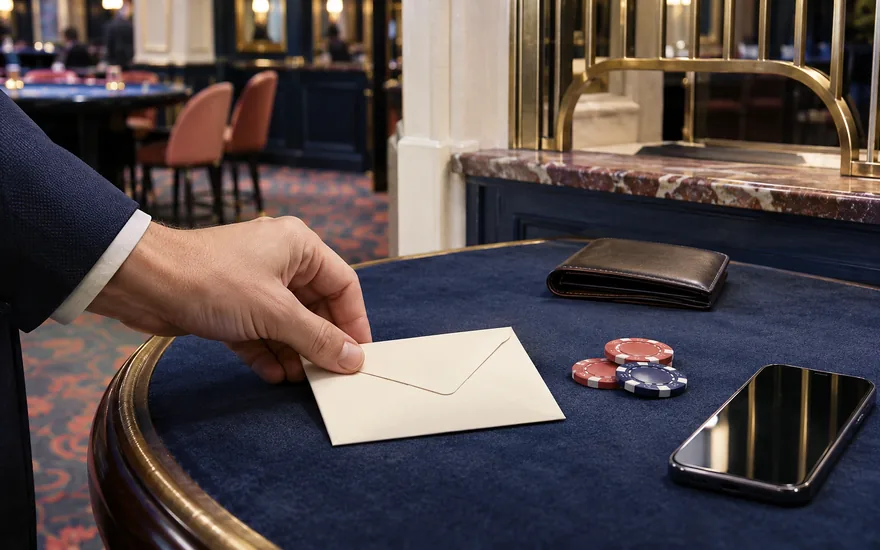
The site's images are original themed illustrations showing recognisable casino objects and situations. Payment pages use cash-desk records, vouchers, phones and chip trays. Named games use motifs corresponding to their subject, such as clovers, crystals, Egyptian symbols or potion bottles. The image should help a reader identify the topic instead of acting as unrelated decoration.
These scenes are not authentic screenshots of a visitor's account or proof that an operator supports a method. They do not verify a displayed balance, document request or game configuration. The written description and primary sources carry those factual claims. The editorial policy explains that separation in more detail.
Alt descriptions name the visible subject so that the image remains understandable when it cannot be seen. Captions contribute a related reading point rather than simply repeating the alt. The generated publication logo is a site identity mark; it is not a casino operator logo and should not be read as an endorsement by a payment provider or game studio.
What happens when a statement is incomplete or disputed
A useful correction identifies the page, sentence and source that appear to conflict. It does not require a reader to prove an entire personal account history. The immediate editorial question is whether the statement is supported for the product, market and period described.
Where a claim cannot be retained, it should be narrowed, corrected or removed. Adding confident language around an uncertain number does not resolve the uncertainty. If two primary summaries differ, the difference itself may need to be explained rather than hidden by selecting whichever value looks more attractive.
The publication's correction process is not an operator dispute-resolution service. It cannot reverse a charge or approve a withdrawal. An account-specific issue belongs with the organisation holding the record. The contact page and complaints guide distinguish a publication question from a request for action on an account.
How much personal information belongs with a general question
Usually a general question about an explanation can be described without account credentials. A page title, the relevant wording and an anonymised example of the ambiguity can establish what needs clarification. A full card number or bank statement adds risk without making the editorial question more precise.
When an actual provider investigation requires private evidence, use that provider's recognised secure process. Keep the original record privately and distinguish it from any redacted explanation prepared for another purpose. A document relevant to one organisation is not automatically appropriate to distribute to an unrelated publication.
The privacy page describes the site's reading features, small session preference and optional provider connections. It also explains why a suggestion window or a page visit is not a casino transaction record. Reading about a process should not be confused with granting a general information site access to the accounts involved.
How the publication is maintained without promising certainty
An editorial review date records a check, not an assurance that every external page will remain unchanged. Providers can change wording, availability and product presentation. The source and observation date therefore stay relevant even when an article has recently been reviewed.
The site also distinguishes an accessible historical example from a current offer. An old page can illustrate a condition without proving that the same award exists today. Removing that distinction would make the prose sound more current while making it less accurate. The detailed comparisons retain the boundary rather than invent a live promotion.
Technical checks support a different kind of reliability. Working internal links, readable tables, image alternatives and a consistent mobile header help the material remain usable. They do not prove that a factual claim about an external account is correct. Both content evidence and interface checks matter, but they answer different questions and should not be presented as substitutes.
Why the site avoids unexplained scores
A score can look precise while concealing what was measured. A star beside a payment method might be mistaken for a test of cost, speed, availability or service, although those are separate attributes. The present publication does not invent such a score to fill an empty space or make a table appear complete.
The same principle applies to a game. An appealing theme, a published theoretical return and a particular feature are different descriptions. Combining them into one apparently scientific rating would require a defined method and supporting evidence. Without that method, a number would add confidence to the page without adding knowledge.
This is why the inactive homepage listing contains no fabricated review count or operator rating. Empty information remains empty. If a future listing is introduced, its claims will need to be supplied and supported on their own terms. A position in a layout cannot supply the evidence that the underlying claim lacks.
Why each article has its own narrow subject
The publication's sections are connected, but their pages are not intended to be interchangeable. A record problem needs its own explanation. An article about a wallet bank transfer should not suddenly become a general ranking of casinos, and a game-rule page should not repeat several unrelated payment guides to make itself longer.
Internal links are used to preserve those boundaries. A short reference can identify the next relevant subject without copying the entire explanation. The reader can then choose whether the additional question matters. This makes the relationship between pages clearer and avoids presenting every possible topic as part of the original problem.
The comparison library is a navigation example of that approach. It explains how five different comparison questions are organised, while each detailed comparison retains its own scope. A publication index can be substantial without pretending to own every underlying question or replacing the individual sources attached to those questions.
What to expect from a finished reading
The useful result is a clearer description of the original question. A reader should be able to distinguish a cash balance from an award, an instruction from a receipt, or a retained symbol from a completed game result. That understanding can make a later enquiry more focused without implying that a particular outcome is guaranteed.
A finished article may leave you with a link to another explanation, a precise question for the organisation holding your record, or enough information to decide against proceeding. All three are useful outcomes. For example, identifying a payment as pending may tell you which provider to ask; discovering that a condition is unclear may be a reason to leave the transaction alone. Reading does not need to lead to account registration or further gambling.
Support for gambling-related harm remains separate from payment research. A person does not need to settle an account dispute or complete the catalogue before seeking independent help. The Help link stays available as a different route. Cashier Trace can explain the labels around a figure; it does not require that the reader keep pursuing that figure through another payment or game.